

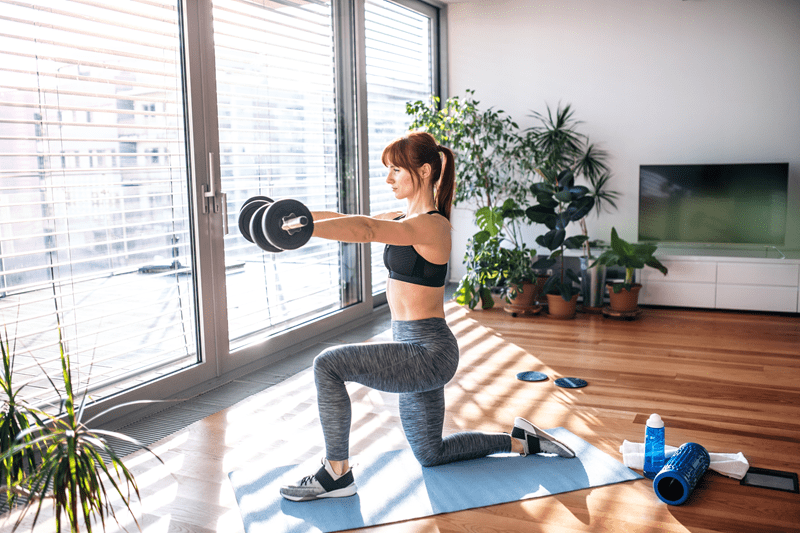
A full-body home workout routine can change your fitness without any fancy machines or a gym membership. People increasingly use no-equipment workouts, efficient exercises with body weight, and a simple yet effective home fitness plan that fits one's schedule and goals. Whether you want a home workout routine for full-body strength, stamina, and mobility or wish to follow the best no-equipment workout for beginners, this guide will help you create a plan that actually works and keeps you motivated.
Below, a detailed breakdown of techniques, structure, and form will be accompanied by professional advice on how to maintain consistency. Let's begin with the best ways to transform your home into your personalized gym.
The best home workout routine is not only about convenience; it's actually one of the most effective ways to be consistent. Remove barriers such as travel time, crowded gyms, and monthly fees, and you have created a fitness lifestyle that is easier to maintain long-term. The much bigger question is
"How can I achieve similar results from a home-based exercise routine, compared to an exercise program at a gym?"
To answer that question, you must be smart with your planning. If you select the best no-equipment exercises as well as the best designs for your body weight exercises, you can create a complete home workout routine that will effectively target all the important areas of your body for maximum strength in addition to building your cardiovascular fitness and increasing flexibility.
A Complete Home Workout Program can also provide the maximum benefits for your body. It provides the best way to achieve a balanced workout that works all of your major muscle groups. The routine allows each muscle group the right amount of rest before being worked again. Using this approach, you can build your arm, leg, and core strength, and improve your chest and back.
This kind of balanced structure leads to:
Many think that one needs machines for full-body training; however, bodyweight exercises can be great if done right. Combining these with some strategic no-equipment workouts makes a simple living room workout a transforming experience.
Most are quite skeptical of no-equipment workouts, opting to think they're way too easy or limited. But when done correctly-with form and intensity-nothing is as powerful.
Here's why:
The best no-equipment workout for beginners incorporates controlled tempo, proper posture, and progressive difficulty—elements that we'll break down below.
A good home workout program is all about consistency and progressions. It should include:
A warm-up gets your joints, muscles, and heart rate ready. Here are some great warm-up bodyweight exercises:
This portion forms the foundation of your home workout routine.
Use this sequence:
Squats (Lower Body)
Push-Ups (Upper Body)
Posterior Chain - Glute Bridge
The glute bridge is a good exercise to strengthen the hamstrings and lower back muscles.
Reverse Lunge - Stability and Strength
The reverse lunge is excellent for building up the leg muscles while also improving the stability of the hip joint.
Plank - Core
A plank works on core strength and good posture.
The whole circuit should be completed 3 - 4 times based on the level of fitness you have.
The following cardio will increase your metabolism and ramp up your endurance in just 10 minutes:
No Equipment Workouts:
The second block of the workout is the Core & Stability Block, and although it is a full workout, you will want to include some dedicated core work in this block.
Stretching Can Help With Reduced Muscle Soreness and Recovery Times:

A newbie to fitness can add their own limitations by changing up a no-equipment workout and keeping it simple.
You can make modifications to the exercises in the following ways:
Using these modifications will help you build strength via beginner-friendly bodyweight exercises while allowing you to avoid injury.
Looking at your balanced home fitness routine, frequency of training plays a major role in determining where you need to go from here. Below is a beginner-to-advanced sample frequency:
Make sure to have your home fitness routine change every 2 weeks between:
Having a varied workout keeps your body guessing and helps to avoid burnout.
Even great home fitness routines can lose their effectiveness if mistakes are made. Here are some common mistakes you want to avoid:
The most foundational element of any bodyweight exercise is that you should maintain correct form. Performing incorrectly during a no-equipment workout can lead to injuries and slow results.
This is a complete weekly programme you can follow:
Do squats, lunges &, push-ups, and planks, are the main focus.
Do high knees, jumping jacks & mountain climbers.
Incorporates Yoga Stretches, Glute bridges & Lots of Core Work
Repeat Monday's routine but with added intensity.
Burpees, sprints in place, side-to-side hops.
Walking, stretching, and low-impact training
This ensures that your muscles recover and grow.
Whether a novice, intermediate, or advanced exerciser, a home workout routine provides scalability.
With regular use, body-weight exercises combined with structured no-equipment workouts and a disciplined home fitness plan can elicit the same, if not even better, results you'd see in a gym.
The biggest advantage of a home workout routine is simply that it cuts out all excuses. No need for equipment, no space required, and absolutely no strict scheduling. All that's needed is commitment and the right plan.
Using no-equipment workouts, effective bodyweight exercises, and a structured home fitness plan, you can build strength, burn fat, and transform your energy levels, right from home.
If you've been looking for a home workout routine for the full body or want the best no-equipment workout for beginners, utilize this guide to start today. Your fitness journey begins where you are, no gym required.
The best full-body home workout is as follows:
Note: The above paragraph is already paraphrased.
Yes, no-equipment workouts build muscle by employing bodyweight resistance, proper form, controlled tempo, and progression. By doing these exercises regularly, you'll strengthen your major muscle groups and improve your overall fitness level.
Most people benefit from a home fitness plan performed 3–5 days weekly. Beginners may start off with three sessions, while advanced users can train up to six days weekly.
Definitely! Low impact, safe, and easy to modify means Bodyweight workouts may help get you started if you are a beginner. They help build foundational strength and improve balance before going on to harder variations.
In order to develop strength, mobility, and confidence, this type of beginner workout that requires no equipment is designed specifically for beginning exercisers to safely perform modified squats, knee push-ups, and all other bodyweight-only exercises under a qualified instructor.glute bridges, slow lunges, planks and some light cardio to help develop these skills and attributes over time.
This content was created by AI